How to Size a Well Pressure Tank (With the Math)
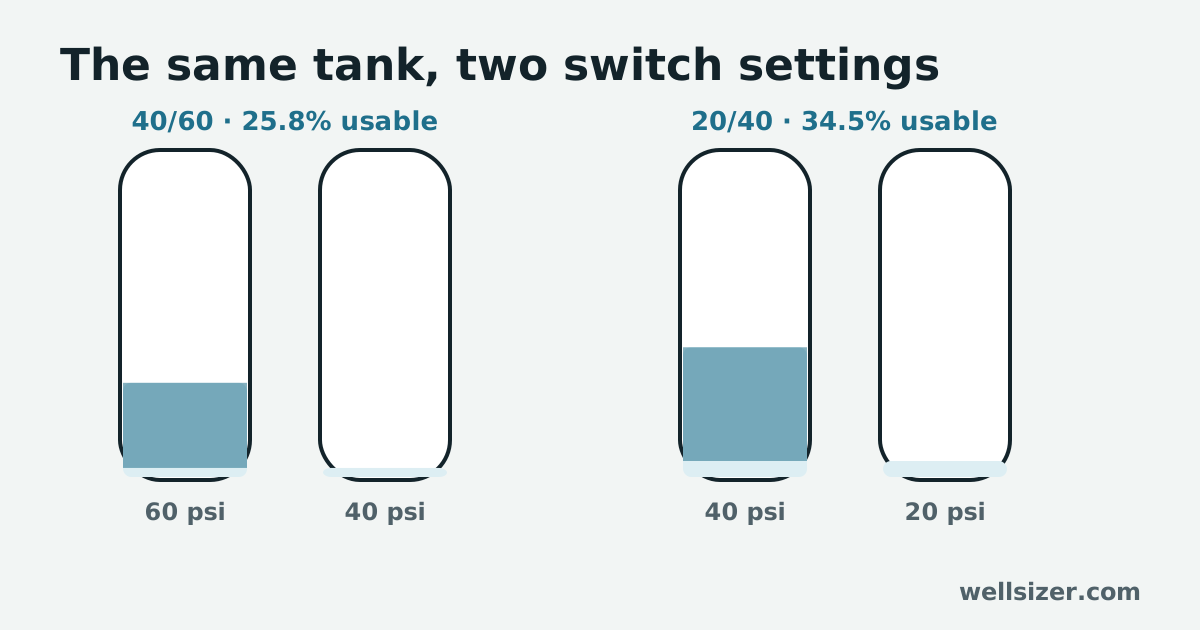
To size a well pressure tank, multiply the pump's flow by the minimum run time, then divide by the share of the tank that is usable at your pressure switch setting. For a 10 gallon-per-minute pump on a 40/60 switch that is 10 × 1 ÷ 0.258 = 38.8 gallons of tank.
Step 1: the drawdown the pump needs
Every start heats a submersible motor. Franklin Electric's installation manual is plain about it: "Run motors a minimum of one minute to dissipate heat build up from starting current." So the tank has to hold at least one minute of pump flow between the moment the pump stops (cut-out) and the moment it starts again (cut-in). That water is the drawdown:
drawdown = pump gpm × run minutes
A 10 gpm pump needs 10 gallons of drawdown; a 14 gpm pump needs 14. Sizing for two minutes doubles it.
Step 2: how much of the tank is usable
A precharged tank starts full of air. As water comes in the air is squeezed, and by Boyle's law the air volume falls in proportion to absolute pressure (gauge pressure plus 14.7 psi). With the precharge set 2 psi below cut-in — AMTROL's instruction — the share of the tank you can draw between the switch points is:
usable share = (precharge + 14.7) × (1 ÷ (cut-in + 14.7) − 1 ÷ (cut-out + 14.7))
| Switch setting | Precharge | Usable share |
|---|---|---|
| 20/40 psi | 18 psi | 34.5% |
| 30/50 psi | 28 psi | 29.5% |
| 40/60 psi | 38 psi | 25.8% |
| 50/70 psi | 48 psi | 22.9% |
The same formula with the precharge equal to cut-in reproduces Goulds' published pressure-factor table (0.37 at 20/40, 0.31 at 30/50, 0.27 at 40/60).
Step 3: divide
tank volume = drawdown ÷ usable share
| Pump flow | 20/40 | 30/50 | 40/60 |
|---|---|---|---|
| 10 gpm | 29.0 gal | 33.9 gal | 38.8 gal |
| 14 gpm | 40.6 gal | 47.4 gal | 54.3 gal |
Then pick the first tank at or above that size. In Goulds' HydroPro line, a 10 gpm pump on 40/60 needs the 45.2-gallon V140, which holds 11.7 gallons between 40 and 60 psi; a 14 gpm pump needs the 65.1-gallon V200. Every flow from 5 to 20 gpm has its own page, starting from pressure tank size, and the calculator takes any flow.
Why manufacturer tables show more drawdown
Tank charts often list drawdown "at 38/60" or "at 28/50". Those figures count water drawn all the way down to the precharge, 2 psi below the cut-in. In use, the pump switches on at cut-in, so the extra 2 psi of water is never drawn between cycles. Goulds' V140 is listed at 13.3 gallons at 38/60; between the real 40 and 60 psi switch points it gives 11.7. Sizing from the switch points, as here, gives a slightly larger tank and keeps the one-minute rule honest.
Things that change the answer
- Precharge. The formula assumes the precharge is 2 psi below cut-in. A tank left at a lower factory precharge holds much less usable water — see pressure tank precharge.
- Two tanks. Tanks in parallel add their drawdowns, so two smaller tanks can replace one large one.
- Constant-pressure systems. Variable-speed pumps follow different rules; this sizing is for ordinary on/off pressure switches.
Multiply flow by run time, divide by the usable share, and round up to the next tank: that is how to size a well pressure tank.
Sources
- Franklin Electric, AIM Manual, Submersible Systems, 60 Hz (2026), published by the Nebraska Department of Water, Energy and Environment — the one-minute run time.
- AMTROL, Well-X1 installation instructions — precharge 2 psig below cut-in.
- Goulds Water Technology (Xylem), Technical Manual TTECHWP R7 — HydroPro tank volumes (Table 1) and pressure factors (Table 2). See the methodology.
Questions
What size pressure tank do I need for a 10 gpm pump?
On a 40/60 switch, at least 38.8 gallons of total tank volume for a one-minute run; on 30/50, 33.9 gallons; on 20/40, 29.0 gallons. Those are the smallest tanks whose usable water between the switch points equals one minute of pumping.
Why does a 40/60 switch need a bigger tank than 30/50?
Air is compressed harder at higher pressure, so less of the tank is usable: about 25.8% between 40 and 60 psi against 29.5% between 30 and 50, with the precharge 2 psi below cut-in.
Is bigger always better?
A larger tank means longer and fewer pump cycles, which is easier on the motor. Two minutes of run time doubles the tank. The limit is space, cost and the water sitting in the tank.