Total Dynamic Head for a Well Pump, Step by Step
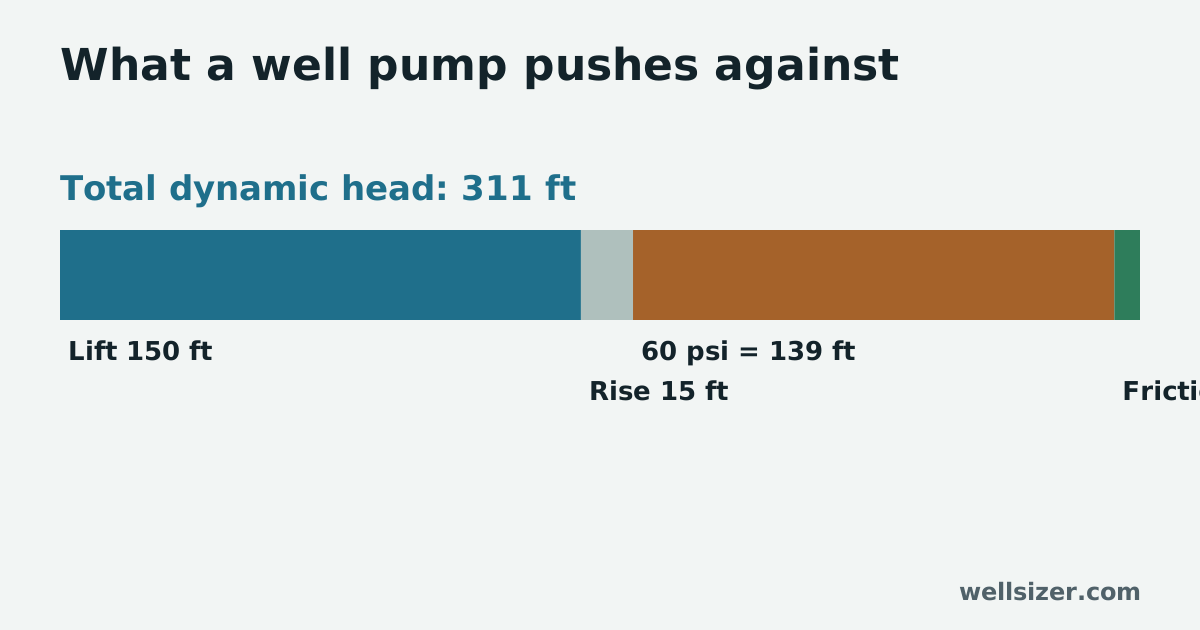
Total dynamic head for a well pump is the sum of four things: the lift from the pumping water level, the rise from the wellhead to the pressure tank, the switch's cut-out pressure converted to feet, and the friction in the pipe. It is the number a pump chart has to beat.
The four parts
- Lift. The depth to the pumping water level — where the water stands while the pump is running, not the static level.
- Rise. How far above the wellhead the pressure tank sits; zero if it is level, negative if downhill.
- Pressure. The pump must reach the cut-out pressure at the tank. Goulds' manual: "H = 2.31 x psi". A 60 psi cut-out is 138.6 feet.
- Friction. Water loses head moving through pipe. Goulds publishes friction loss per 100 feet for Schedule 40 plastic pipe by flow.
A worked example
A three-bathroom house wants 14 gpm (Goulds' peak-demand figure for 2 to 2½ bathrooms). The pumping level is 150 feet, the tank is 15 feet above the wellhead, the switch is 40/60, and 220 feet of 1¼-inch plastic pipe runs from the pump to the tank.
| Part | Feet |
|---|---|
| Lift to pumping level | 150 |
| Rise to the tank | 15 |
| 60 psi × 2.31 | 138.6 |
| Friction, 14 gpm in 220 ft of 1¼" pipe | 7.4 |
| Total dynamic head | 311 |
Change the pipe and the friction changes sharply: the same run in 1-inch pipe loses 28.8 feet, in 1½-inch only 3.4.
From head to a pump
Goulds' 10GS selection chart is laid out by depth to water and pressure rather than total head, so the calculator adds the rise and friction to the depth — 150 + 15 + 7.4 = 172 feet — and reads the chart at the next listed depth, 180 feet. At 180 feet the smallest model that gives 14 gpm at the 40 psi cut-in and is still rated at 60 psi is the 1½ hp 10GS15: 15.1 gpm at 40 psi, 13.9 at 60. A 10 gpm demand at the same depth needs only the 1 hp 10GS10.
Every depth from 60 to 380 feet has its own table on well pump size by depth, and the pump calculator runs this example for your numbers.
Mistakes that undersize a pump
- Using the static level instead of the pumping level.
- Forgetting the rise when the house is uphill of the well.
- Using the cut-in pressure instead of the cut-out: the pump has to finish filling the tank.
- Leaving out friction on a long run of small pipe.
Add lift, rise, pressure and friction, and the total dynamic head for a well pump tells you which row of the chart to read.
Sources
- Goulds Water Technology (Xylem), Technical Manual TTECHWP R7 — "H = 2.31 x psi", Schedule 40 plastic pipe friction loss, private-residence peak demand.
- Goulds 10GS selection chart (brochure B5-25GS) — pump ratings by depth and pressure. See the methodology.
Questions
How do I convert psi to feet of head?
Multiply by 2.31. Goulds' technical manual gives it as H = 2.31 × psi, so a 60 psi cut-out adds 138.6 feet.
Do I use the static water level or the pumping level?
The pumping level — the depth the water falls to while the pump runs. It comes from the driller's log or a pump test and is deeper than the static level.
Does pipe size matter much?
At household flows, a lot. 14 gpm through 220 feet of 1-inch plastic pipe loses about 28.8 feet of head; through 1¼-inch pipe about 7.4 feet.